
Sometimes it’s not the number of things you need to do that feels overwhelming.
It’s that everything feels equally important.
The unread email.
The unanswered text.
The task you’ve been avoiding all week.
The meeting that’s not for another three weeks but keeps hovering in the back of your mind.
When nothing stands out as clearly more important, deciding where to start can feel impossible.
And the longer you sit in that feeling, the heavier it gets.
That mismatch between how your brain processes urgency and how modern life delivers it is what creates the constant sense of overwhelm.
When Nothing Is an Emergency, But Everything Feels Like One
Here’s a familiar moment.
It’s mid-afternoon. You’re finally making progress on something that actually matters when a notification pops up. A “quick question.” An email with no context. A message that technically could wait, but doesn’t feel like it can.
Your body reacts before you’ve had a chance to think. Focus breaks. Attention shifts. The task you were working on gets abandoned, not because it wasn’t important, but because something else suddenly felt louder.
By the end of the day, you’re exhausted. Busy, but behind. And carrying a vague sense that you dropped the ball somewhere, even if you can’t name where.
Nothing exploded. Nothing urgent actually happened.
But your nervous system didn’t know that.
Why Your Brain Treats Everything as Urgent
Your brain doesn’t naturally rank tasks by importance. It responds to immediacy, pressure, and emotional weight first.
Most productivity advice assumes urgency helps you decide what matters. That you can look at a list, identify what’s important, and move through it calmly.
That only works if your brain naturally distinguishes between importance and immediacy.
For many women with ADHD or those executive function challenges, that distinction doesn’t happen automatically.
Tasks without pressure live in a kind of mental limbo. You know they matter. You know you should do them. But without a deadline, a waiting person, or a consequence attached, they don’t register as actionable.
Add urgency, though, and everything changes.
A deadline approaches. Someone is waiting. There’s a risk of disappointing someone.
Suddenly your brain lights up. Stress hormones and dopamine kick in. You can move.
This is why you’re often brilliant under pressure. Why can you pull something together at the last minute that surprises even you.
Why crisis mode feels productive.
It’s also why you’re tired.
Your nervous system doesn’t differentiate well between real emergencies and routine tasks that carry expectations.
An email from your boss, a text from a friend, a permission slip for school, and a presentation due next month can all trigger the same internal alarm.
Your body responds as if everything needs immediate attention.
All day long.
The Cost of Living in Crisis Mode
When urgency becomes the primary way your brain accesses motivation, you start depending on it.
- You wait until the pressure is high enough to act.
- You let deadlines drift closer than you’d like.
- You overcommit, over-schedule, or keep your calendar full because external pressure helps you function.
Over time, urgency stops being a tool and becomes a baseline.
The work that actually matters, the work that requires sustained attention, clarity, or creative thinking, keeps getting pushed aside. Not because it isn’t important, but because it doesn’t generate the same internal signal as urgency.
Meanwhile, your energy gets spent responding. Checking. Answering. Reacting.
It looks like productivity. It feels like effort. But it doesn’t create momentum.
Why “Just Prioritize” Doesn’t Work
We’ve been told to just focus on what’s important.
The problem is that importance can be abstract.
Recognizing importance requires access to executive function. It asks your brain to think long-term, weigh trade-offs, and tolerate discomfort now for payoff later.
Urgency, on the other hand, is visceral. It comes with emotion, immediacy, and relief once it’s handled.
When your executive function is depleted, stressed, or overloaded, your brain defaults to what feels actionable. That’s urgency.
So when someone tells you to “just prioritize,” what they’re really asking is for you to use a cognitive resource that’s already maxed out.
No amount of color-coding fixes that.
The Hidden Driver: Hot State vs Cool State Thinking
Behavioral research describes decision-making in two broad modes:
- In a calm, regulated state, you can think clearly. You understand what matters. You can plan, prioritize, and make intentional choices.
- In a stressed or emotionally activated state, decision-making shifts. Your brain focuses on immediacy, discomfort avoidance, and emotional relief. Whatever feels loudest takes over.
If you’re spending most of your days in the second state, urgency will always win. Not because it’s right, but because it’s accessible.
That’s why trying to decide what matters in the moment rarely works. You’re asking your brain to do strategic thinking while it’s already under strain.
Why Everything Ends Up Feeling Equally Important
Over time, urgency bias flattens your internal priority system.
Laundry feels as pressing as work.
A Slack message feels as important as a long-term goal.
An unanswered text carries the same weight as a real deadline.
They are not equal in any sense, but your brain no longer has a reliable internal filter.
When that happens, avoidance starts to make sense. If everything is urgent, starting anywhere feels risky. You don’t know which choice will cost you the least.
So you stall. Or you react to whatever is loudest. Or you stay busy with small tasks because they offer quick resolution.
None of that means you don’t care.
It means your system needs support.
This is the point where most people get stuck because urgency makes it hard to tell in the moment.
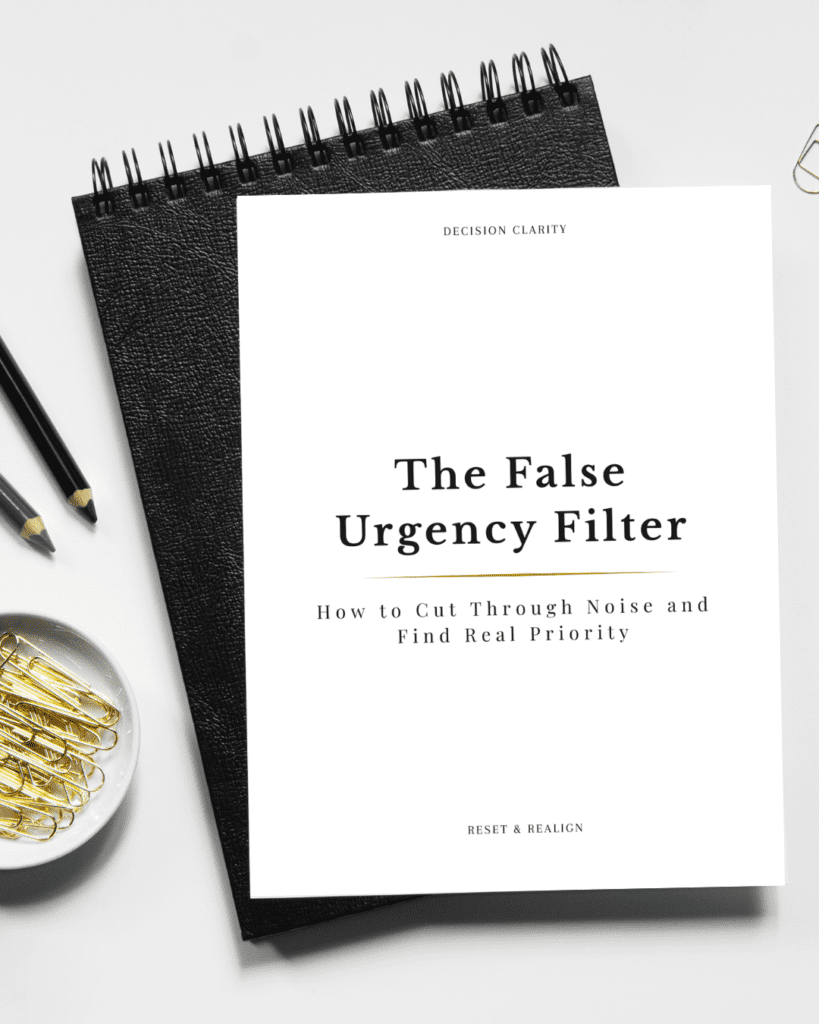
That’s why I use a simple urgency filter when everything feels equally important. It’s a short decision check that helps you pause long enough to separate what’s loud from what actually needs your attention.
If you want it, you can download it here and use it the next time urgency takes over.
What Actually Helps: External Priority Support
You don’t fix urgency bias with willpower. You work around it.
The most effective shift is moving priority decisions out of the moment and into a calmer context.
Instead of asking, “What should I do right now?” when everything feels urgent, you decide in advance what matters and let that decision carry you through the day.
This looks like:
- Deciding on a small number of outcomes that actually matter this week
- Making those priorities visible so you don’t have to re-decide them under pressure
- Creating simple rules that reduce how often urgency gets to interrupt your focus
You’re giving your brain fewer decisions to juggle when it’s already overloaded.
Permission Changes Outlook

There’s another piece that doesn’t get talked about enough.
PERMISSION.
Many women stay stuck in urgency mode because they haven’t given themselves permission:
- To let things wait.
- To disappoint someone temporarily.
- To leave a message unanswered until it actually fits.
Responsiveness becomes tied to worth. If someone is waiting, it must be urgent. If you don’t respond immediately, you’re failing.
But most things aren’t emergencies. They’re requests. Expectations. Discomfort.
Once you allow yourself to separate urgency from importance, space opens up.
Space for focus.
Space for clarity.
Space for the work that actually moves your life forward.
A Different Relationship With Urgency
Urgency isn’t the enemy. It’s information.
The problem starts when urgency becomes the only signal your brain trusts.
When you build external structures to help you decide what matters before everything starts shouting, urgency loses its grip. It becomes something you can notice without obeying.
The email can wait.
The text can wait.
The small, noisy tasks can wait.
What can’t wait is giving yourself a way to decide what deserves your energy before everything feels like an emergency.
Clarity doesn’t come from doing more. It comes from deciding less, on purpose.
And that’s a skill you can support, not a trait you’re missing.