When Your ADHD Brain Won’t Cooperate
You stood in your closet for fifteen minutes this morning, staring at clothes you’ve worn a hundred times before, unable to choose an outfit. Later, you spent forty minutes researching the “best” organizing tools and app instead of actually organizing your space.
By afternoon, when your teenager asked what’s for dinner, you nearly had a meltdown over frozen pizza versus takeout.
If this sounds like your Tuesday (or any day ending in “y”), you’re experiencing something millions of women with ADHD know intimately but rarely understand fully.
What you’re dealing with isn’t character weakness or poor time management. You’re caught in the crossfire between two distinct but interrelated ADHD challenges: decision fatigue and executive dysfunction.
The distinction matters more than you might think. Understanding which one you’re experiencing at any given moment can transform how you respond, what strategies you choose, and ultimately, how much energy you have left for the things that actually matter to you.
What Is Decision Fatigue in ADHD?

Decision fatigue is exactly what it sounds like: your brain getting exhausted from making choices. But for women with ADHD, this exhaustion hits harder and faster than for neurotypical brains.
Every decision, from selecting which email to answer first to choosing your lunch, depletes what researchers call your cognitive resources.
Think of it like a phone battery that drains throughout the day. The difference is that ADHD brains start with less battery life and drain faster.
The Science Behind ADHD Decision Fatigue
Research from functional MRI studies shows that during decision-making tasks, ADHD brains must work significantly harder, activating multiple brain regions that typically stay quiet in neurotypical brains. This extra effort accelerates mental exhaustion.
The culprit is often dopamine dysregulation. Dopamine drives motivation and reward processing, but ADHD brains have less available dopamine to begin with. So, each decision depletes this already limited supply, making subsequent choices feel increasingly overwhelming.
How Decision Fatigue Shows Up in Daily Life
Decision fatigue doesn’t announce itself with fanfare. It creeps in through seemingly unrelated struggles:
- Procrastinating on important tasks after making several small decisions
- Feeling overwhelmed by simple choices (like what to cook for dinner)
- Making impulsive purchases or choices later in the day
- Avoiding decisions altogether, leading to missed deadlines or opportunities
- Snapping at family members over minor requests that require input
Understanding Executive Dysfunction: The ADHD Brain’s Control Center
Executive dysfunction is different from decision fatigue, though they often occur together. While decision fatigue is about mental exhaustion from choices, executive dysfunction involves structural challenges with your brain’s management system.
Executive functions are like your brain’s CEO. They handle planning, organizing, initiating tasks, managing emotions, and controlling impulses. In ADHD, this CEO is working with outdated software and a unreliable internet connection.
Executive Function Deficits vs Executive Dysfunction Symptoms
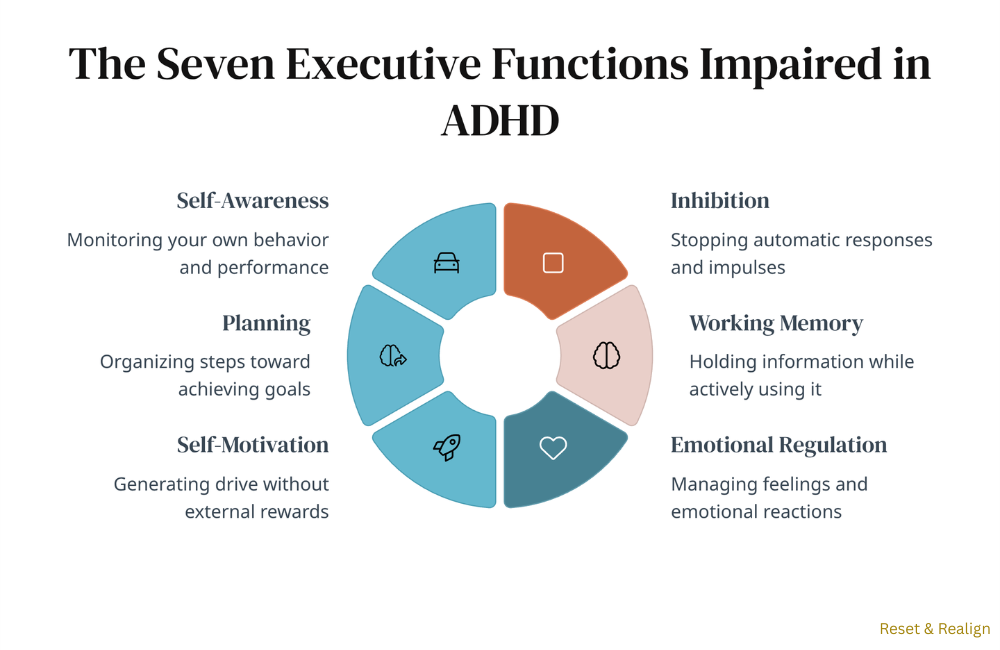
Russell Barkley, a leading ADHD researcher, identifies seven key executive functions that are impaired in ADHD:
- Self-awareness – monitoring your own behavior
- Inhibition – stopping automatic responses
- Working memory – holding information while using it
- Emotional regulation – managing feelings and reactions
- Self-motivation – generating drive without external rewards
- Planning and problem-solving – organizing steps toward goals
When these systems malfunction, you might find yourself knowing exactly what needs to be done but feeling unable to do it. As Barkley puts it: “It is not that the individual does not know what to do. It is that somehow it does not get done.”
Why Executive Dysfunction Isn’t Just Procrastination
Here’s what many people misunderstand: executive dysfunction isn’t a choice. It does not happen because you are unmotivated or careless.
According to the Cleveland Clinic, executive dysfunction happens when the brain regions responsible for self-control, planning, and organization don’t function as they should in neurotypical individuals.
This means the parts of your brain that would typically help you start a task, stay focused, or follow through simply aren’t cooperating, regardless of how much you want to succeed.
Decision Fatigue vs Executive Dysfunction: Key Differences
Understanding the difference between these two challenges can revolutionize how you approach your daily struggles.
When Decision Making Becomes Overwhelming
Decision fatigue typically:
- Gets worse throughout the day as you make more choices
- Improves with rest and recovery
- Responds well to simplifying options
- Affects the quality of your choices, not necessarily your ability to act
Executive dysfunction typically:
- Can occur at any time, regardless of how many decisions you’ve made
- Persists even when you’re well-rested
- Responds to external structure and support systems
- Affects your ability to initiate, sustain, or complete actions
The Root Causes: Cognitive Load vs Brain Structure

Think of decision fatigue like a muscle that gets tired from overuse.
With rest and strategic planning, that muscle can recover and perform better.
Executive dysfunction is more like having a sprained ankle. No amount of willpower will make that ankle work normally.
You need proper support, accommodations, and sometimes professional intervention to function effectively.
How Both Impact Your ADHD Daily Struggles
In real life, decision fatigue and executive dysfunction rarely occur in isolation. They feed each other in a cycle that can feel impossible to break.
The Domino Effect: From Decision Paralysis to Executive Function Breakdown
Picture this scenario:
You wake up already behind schedule (executive dysfunction affecting time awareness).
You struggle to choose an outfit (decision fatigue from yesterday’s accumulated choices). This makes you late for work (executive dysfunction with planning).
You spend your lunch break researching the “perfect” meal prep containers instead of eating (decision fatigue leading to analysis paralysis).
By evening, you’re too mentally exhausted to tackle the important project that’s been sitting on your desk for weeks (both systems in complete breakdown).
Why Small Choices Feel Like Mount Everest
For women with ADHD, especially those juggling careers and family responsibilities, this compound effect creates what researchers call “cognitive overload.” Your brain, already working overtime to manage executive function challenges, becomes overwhelmed by the sheer volume of daily decisions.
The mental load that many women carry—remembering family schedules, managing household needs, tracking work deadlines—adds layers of decision fatigue on top of existing executive dysfunction.
Practical Strategies to Manage Decision Fatigue and Executive Dysfunction
The good news? Once you understand what you’re dealing with, you can develop targeted strategies that actually work.
Decision Fatigue Coping Strategies That Actually Work

Simplify and automate wherever possible:
- Create a capsule wardrobe with pieces that all coordinate
- Plan weekly meals in batches, rotating between 3-4 regular schedules
- Use template responses for common emails or texts
- Set up automatic bill payments and subscriptions
Use the “good enough” principle: For non-critical decisions, aim for satisfactory rather than perfect. The time and energy you save can be redirected toward choices that truly matter.
Implement the 24-hour rule: For important decisions, gather information today but commit to choosing tomorrow when your mental energy is restored.
Research from Psychology Today confirms that these approaches can significantly reduce the mental toll of daily decision-making for people with ADHD.
Executive Dysfunction Treatment: Building Your Support System
Create external structure:
- Use timers and alarms to prompt transitions
- Break large tasks into specific, actionable steps
- Work alongside others (body doubling) for accountability
- Use visual reminders and checklists
Modify your environment:
- Remove distractions from your workspace
- Set up your space the night before for morning success
- Use apps that block distracting websites during work time
Practice self-compassion: Remember that executive dysfunction is a neurological difference, not a personal failing. You wouldn’t criticize someone for needing glasses to see clearly.
Creating Your Personal Management Toolkit
The PAUSE & ACT™ Method for ADHD Decision Making
When facing a decision, try my PAUSE & ACT™ framework:
P = Put it in writing
A = Assess impact
U = Understand your patterns
S = Set your values
E = Emergency plan
The full guided version with worksheets and examples is inside the Permission to Achieve Planner.
Moving Forward with Understanding
The next time you find yourself stuck, ask: Am I dealing with decision fatigue, executive dysfunction, or both? This simple question can guide you toward the right response.
If it’s decision fatigue, rest and simplification are your allies. If it’s executive dysfunction, structure and support systems will serve you better. Most often, you’ll need a combination of both approaches.
Understanding these differences can help you in creating systems that honor how you function rather than how you think you should function.
Your ADHD brain may process decisions and executive tasks differently, but different doesn’t mean deficient. With the right knowledge and strategies, you can reclaim your energy for the ambitious goals that matter most to you.
Disclaimer: This content is for informational purposes only and is not intended as medical advice. Always consult with healthcare professionals regarding ADHD symptoms and treatment options.
Citations & Further Reading
- Cleveland Clinic: Executive Dysfunction
- Psychology Today: Overcoming Decision Fatigue in ADHD
- Barkley, R. A. (2015). Executive Functions: What They Are, How They Work, and Why They Evolved. Guilford Press.
- ADDitude Magazine: Executive Function and ADHD research articles
- ADDA (Attention Deficit Disorder Association) executive dysfunction resources